


Chief Operating Officer (COO) Programme
Future-Proof Your Career
Emeritus and Singapore Management University unite to offer an exclusive opportunity. Enrol by Invalid liquid data and get Invalid liquid dataprogramme fee benefit. Limited seats available. Reserve your spot today!
Application Fee: Invalid liquid data
About the Chief Operating Officer Programme
74%
90%
52%
Your COO Journey Starts Here!
Programme Highlights

Pre-recorded video lectures by NTU Singapore faculty for self-paced learning

Live online sessions conducted by NTU Singapore faculty

Industry relevant capstone project

Programme completion certificate from Nanyang Technological University Singapore

Associate alumni status and benefits

Live doubt-solving sessions and personalised support from industry leaders (Success Coach)

1-day immersion and networking opportunity at NTU Singapore campus (at the end of the programme)

Live masterclasses led by industry experts
The programme highlights presented above are approximate, and subject to change depending on the availability and expertise of the teaching faculty, as well as the programme's desired outcomes.
The programme is designed to be delivered approximately over 7 to 8 months in a calendar year, including some occasional breaks that may be provided. This is only indicative. The actual calendar time may be more or less by a few weeks depending on the number of topics covered and other variables like breaks provided/not provided."
Assignments are reviewed either by a success coach who is available to support participants in their learning journey and/or by the Emeritus grading team. The final number of quizzes, assignments and discussions will be confirmed closer to the programme start.
*This is a majorly self-paced online programme with some live sessions with programme faculty. Post- session video recordings will be available for up to 12 months after programme completion. We have a curated panel of industry practitioners who will be conducting the weekly live doubt-clearing sessions.
**For the on-campus networking session participants will be responsible for making their own travel and accommodation arrangements.
This programme will be delivered in English language
Learning Outcomes

Align strategy with operations to lead with agility in the VUCA world and drive innovation-led excellence.

Learn to design sustainable, resilient global supply chains and manage performance effectively.

Build financial leadership by mastering cost control, capital planning, and risk management.

Formulate data strategies, govern analytics and leverage data for competitive advantage and operational agility

Explore the role of AI, IoT and automation in operations and integrate sustainability into corporate strategy for a green economy

Implement agile leadership, advanced talent strategies, and sustainable operations for leading high-performing teams in today's dynamic business environment
Who is this programme for?
Drive alignment between strategy and operations through tech-led innovation.
Mid to Senior Professionals at pre-CXO level: Aspiring COOs, operations professionals, and business leaders aiming to elevate their leadership impact, improve cross-functional execution, and prepare for C-suite responsibilities. Ideal for those looking to drive transformation, operational efficiency, and organizational growth in their current roles as they progress toward COO positions.
Senior Professionals at CXO levels: Newly appointed and evolving Chief Operating Officers or CXO-level executives seeking to sharpen their strategic, financial, and innovation capabilities. Suited for leaders focused on enhancing enterprise-wide operational excellence, leveraging digital technologies, and aligning operations with long-term business value and agility.
Some key designations include: Chief Operating Officer, Director of Operations, Head of Operations, General Manager, Vice President (Operations), Head of Business Operations, Business Unit Head, Project Director, Head of Tech Operations, Senior Director Operations, Supply Chain Director, Managing Director, Senior Operations Manager, Assistant Vice President Operations, Business Transformation Head.
Programme Modules
Pillar 1: COO as a Strategic Catalyst
Module 1: Vision, Strategy & Execution to Drive Operational Excellence
Analyse Simon Sinek's Golden Circle and evaluate the VSEM framework’s components to drive organisational success.
Describe the three horizons framework for managing growth and fostering innovation.
Discuss the five strategic choices vital for integrated strategic decision-making.
Assess winning aspirations using the "Playing to Win" framework and explain Diageo’s application for industry leadership.
Module 2: Global Supply Chain Management
Describe supply chain components—including suppliers’ and manufacturers’ roles—and the design and operations phases to enhance cost reduction and customer satisfaction.
Discuss how an organisation’s strategy addresses supply chain challenges and decisions across global industries.
Analyse the impact of customer requirements and product demand uncertainty on implied demand uncertainty.
Evaluate trade-offs between responsiveness and efficiency while aligning supply chain operations with customer demand and supply source uncertainty.
Module 3: Drivers and Metrics for Supply Chain Performance
Analyse supply chain drivers for their impact on responsiveness, efficiency, and strategic fit.
Evaluate performance metrics—such as facility and inventory metrics—to align supply chain operations with business strategy.
Discuss transportation and information metrics for achieving strategic fit and enhancing organisational objectives.
Assess sourcing and pricing metrics for their role in facilitating strategic alignment in decision-making.
Module 4: Network Design and Inventory Modelling
Discuss how facility number, location, and macroeconomic factors influence supply chain performance and network design.
Evaluate a comprehensive network design framework that incorporates supply chain strategy, regional facility choices, and variable interactions.
Examine inventory’s strategic role by analysing the advantages and disadvantages of holding stock.
Calculate inventory costs, model cycle inventory trade-offs, and discuss implementation issues to recommend strategies for optimising service levels and safety stock.
Module 5: Demand and Supply Coordination
Discuss how aligning supply chain entities enhances surplus and analyse coordination issues, including the bullwhip effect from information distortion.
Identify key strategies and managerial levers to improve alignment and coordination across the supply chain.
Evaluate practical approaches—such as continuous replenishment and vendor-managed inventory—for boosting efficiency.
Assess the environmental impact of supply chains and describe blockchain technology’s role in streamlining decision-making processes.
Module 6: Customer Centricity
Discuss customer-centric strategies that align operations to drive loyalty, revenue growth, and long-term business success.
Analyse customer journey mapping and data-driven personalisation to optimise operational processes and enhance experiences.
Identify key touchpoints, pain points, and opportunities within customer journeys to refine strategies.
Evaluate customer data trends and segmentation techniques to support personalised decision-making and operational efficiency.
Pillar 2: Functional Mastery for COOs
Module 7: Financial Leadership for COOs – Part 1
Discuss the role of accounting and finance in business, emphasizing their strategic importance for organisational success.
Analyse the strategic roles of managerial accounting by examining cost behaviours and the effects of cost structure changes on profitability and operations.
Assess the significance, efficiency, and efficacy of working capital management in safeguarding financial health, enhancing operational efficiency, and supporting sustainability.
Evaluate the impact of market and firm-specific risks on financial reporting and decision-making, while discussing the need for an improved measurement systems.
Module 8: Financial Leadership for COOs – Part 2
Discuss the critical role of financial information in business processes and its link to organisational relevance.
Explain financial statement elements and analyse their significance for informed decision-making.
Discuss the business implications of financial statements in shaping overall organisational strategy.
Demonstrate financial statement analysis techniques to address business issues and recommend solutions for organisational challenges.
Module 9: Data-Driven Decision-Making and Analytics – Part 1
Discuss the key components of a data strategy, analyse associated challenges, and propose coherent actions for high-stakes organisational issues.
Analyse data governance components—including data security, privacy, and essential management processes—to ensure robust organisational data practices.
Discuss the differences between analytics, AI, ML, and deep learning, and analyse the transformative role of AI/ML in enhancing decision-making and operational efficiency.
Evaluate model effectiveness by examining the charts versus models, analysing supervised and unsupervised learning approaches, and assessing model explainability.
Module 10: Data-Driven Decision-Making and Analytics – Part 2
Discuss how historical events can be modelled to synthesise insights for improved organisational decision-making.
Analyse model training and testing processes to enhance predictive accuracy and support effective decision-making.
Evaluate robust error estimation techniques—including 10-fold cross-validation—to assess their impact on predictive accuracy.
Analyse the application of regression and CART models by examining linear regression, logistic regression, and CART predictions to refine organisational strategies.
Pillar 3: Technology Led COO
Module 11: Role of Technology, Data, and AI in Operational Efficiency and Optimisation
Discuss how AI-driven technologies enhance operational efficiency, sustainability, and human-AI collaboration, and analyse how data and AI support strategic foresight in planning.
Demonstrate how the intelligence cycle converts raw data into actionable insights for strategic decision-making by leveraging dynamic insights and analytics stages.
Evaluate and demonstrate how the Data Science Hierarchy of Needs aids organisations in building advanced AI capabilities and optimising operational efficiency.
Analyse predictive planning techniques to improve operational forecasting and align strategies with organisational vision.
Module 12: Data-Driven and Innovation-Led Leadership
Apply data from the Data Pyramid to make strategic decisions that improve operational efficiency.
Discuss Decision Needs Analysis to optimise operational decision-making and align strategies with organisational objectives.
Apply Decision Needs Analysis to optimise inventory management by reducing costs and improving customer satisfaction.
Evaluate how integrating data-driven insights with Decision Needs Analysis fosters innovation-led leadership and continuous operational improvement.
Module 13: AI and Its Impact on Enterprise
Analyse AI's evolution from rule-based systems to deep learning and its impact on driving organisational innovation and optimising decision-making.
Analyse how supervised, unsupervised, and reinforcement learning enhance decision-making within organisations.
Assess AI's alignment with human senses to improve both innovation and decision-making processes.
Evaluate how emerging AI technologies—including computer vision, forecasting, and platforms —improve operational efficiency, disrupt industries, and enhance product development.
Module 14: Generative AI Impact on Enterprise Organisation
Analyse how Human-Centered and Human-in-the-Loop AI approaches drive operational excellence and enhance decision-making.
Discuss how AI-human collaboration improves efficiency, performance, and fosters innovation in organisational operations.
Analyse and evaluate examples of responsible versus irresponsible AI applications and assess AI's dual role in security and decision-making to foster ethical practices.
Discuss the impact of advanced analytical techniques and the implementation of FEAT principles in AI strategies to enhance organisational effectiveness, integrity, and trust.
Module 15: The Future of IoT, Automation, and Robotics
Discuss the key pillars of Industry 4.0 and their role in shaping the foundation for Industry 5.0.
Evaluate Industry 5.0 principles to enhance organisational strategies for human-centric and sustainable production.
Assess Industry 5.0 technologies for improving operational efficiency and driving sustainable organisational growth.
Analyse the strategic benefits of transitioning from Industry 4.0 to 5.0 in elevating the COO's role and overall organisational performance.
Module 16: Human Capital Management
Discuss how Human Capital Management leverages data-driven workforce insights to enhance decision-making and optimise performance.
Analyse the shift from HRM to HCM and its impact on aligning employee development with organisational strategic goals, engagement, and productivity.
Apply HCM strategies to optimise workforce planning in alignment with organisational objectives.
Assess the effectiveness of HCM strategies in fostering innovation and driving organisational growth.
Pillar 4: Future Ready COO
Module 17: Organisational Design and Transformation
Discuss various types of organisational change and their strategic relevance in enhancing business success.
Analyse the four pillars of cultural transformation and their impact on fostering organisational success.
Analyse driving and restraining forces using Force Field Analysis and evaluate strategies to manage resistance to transformation.
Formulate inclusive, high-involvement transformation strategies that align organisational goals with employee engagement.
Module 18: The 21st Century Leader Capabilities
Analyse leadership strategies, organisational norms, and the role of culture in mitigating toxic environments while fostering innovation, adaptability, and collaboration.
Develop strategies to enhance cultural intelligence for effective integration—and assess its role in mergers—to boost organisational effectiveness and profitability.
Formulate approaches for leading advisory boards effectively to drive success in competitive markets.
Discuss the SCARF model’s application to enhance communication and influence within organisational leadership.
Module 19: Building and Leading High-Performing Teams: Part 1
Analyse and evaluate the differences between high- and low-performing teams, recognising the COO’s role in addressing development challenges and fostering excellence.
Understand the integrative model by analysing three mechanisms that collaboratively create effective, high-performing teams.
Evaluate strategies to enhance organisational culture and examine how structure influences teamwork and collaboration.
Analyse a software engineering case study to reflect on necessary adjustments in organisational structure components.
Module 20: Building and Leading High-Performing Teams: Part 2
Enhance leadership style and recognise the COO’s role in building agile teams that drive organisational goals.
Identify and optimise team structures, compositions, and member competencies to boost dependability, productivity, and workplace harmony.
Understand and implement essential team processes and strategies to improve dynamics and foster effective collaboration.
Apply a four-dimensional framework for resource allocation and develop strategies to overcome challenges in virtual team settings.
Module 21: Communicating in the C-Suite: Influence and Persuasion – Part 1
Analyse how attitudes, values, beliefs, and the interplay of motivation and ability influence decision-making and persuasion.
Evaluate communication scenarios to determine when to use central versus peripheral routes, applying the Elaboration Likelihood Model for tailored messaging.
Discuss and assess techniques for crafting messages that resonate with stakeholder motivations and drive alignment.
Evaluate strategies for overcoming resistance and objections while reviewing core concepts of influence and persuasion in the C-suite.
Module 22: Communicating in the C-Suite: Influence and Persuasion – Part 2
Discuss and apply the six principles of influence—including Cialdini's principles—to real-world communication scenarios.
Evaluate and apply narrative persuasion techniques to foster engagement and influence decisions in professional contexts.
Apply the Toulmin method to construct logical arguments, rebuttals, and develop persuasive business cases.
Create integrated communication frameworks that leverage influence principles, narrative strategies, and logical argumentation while addressing objections and resistance.
Module 23: Leadership in the Green Economy
Discuss key sustainability concepts and strategic leadership practices that drive effective organisational strategies and operational decisions for competitive advantage.
Implement the Higher Purpose Framework to integrate sustainability and equity into organisational strategies and operations.
Apply Green Economy principles and Sustainable Development Goals to enhance organisational sustainability and social responsibility initiatives.
Analyse how Johnson Controls’ digital transformation enhances sustainability and operational efficiency in intelligent building solutions.
Masterclasses by Industry Experts

Insights into Operational Synergies and Integration during Corporate Restructuring

Leveraging Digital Twin in Supply Chain Management

Integrating Circular Economy principles into Operations

Hyper-Automation Business Examples beyond RPA
Supply Chain Simulation Game

Strategic Decision-Making
Make critical choices on factory expansion, inventory thresholds, batch sizes, and shipping methods to optimize supply chain efficiency and financial performance.

Market Expansion
Enter new markets, manage inventory levels, and optimize logistics to drive growth and profitability.

Technology Transition Management
Navigate the phase-out of current foam technology by effectively managing production and distribution strategies.

Competitive Performance
Make real-time strategic decisions to maximize cash flow and outperform competitors in a dynamic market environment.
Note: The simulation game objectives, learning outcomes, and the platform may change as per faculty's discretion without prior notice.
Case Studies












Note: All product and company names mentioned in this material are trademarks or registered trademarks of their respective holders. Their use does not imply any affiliation with or endorsement by them. The above case studies are indicative and they are upto faculty discretion
Programme Learning Experience

Hands-on Capstone Project
Apply yourself to a real-world hands-on challenge

Case-based Insights
Case-Analysis based class discussions and presentations

Insights from Industry Experts
Gain cutting-edge insights from Industry Leaders

Simulation Game
Hands-on Simulation activity on Supply Chain Management

Playbook Activities
Assimilate modular learnings through playbook activities

Graded Assessments
Get detailed feedback on your assignment submissions

Scenario-based Quizzes
Test your decision-making with real-world business scenarios
Programme Faculty
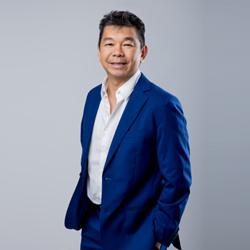
Alvin NG Theng Haw
Adjunct Associate Professor
Alvin Ng has over 25 years of leadership experience, holding key positions in renowned organizations such as Cisco Systems, General Electric, and Johnson Controls. As Regional...

Jian Ming (Jane)
Associate Professor (Practice)
Dr. Jian Ming has been in the College of Business (Nanyang Business School) since August 2003. She received her bachelor’s degree in accounting from Zhongshan University in th...

Rohit Bhatnagar
Associate Professor
Dr. Rohit Bhatnagar is currently associate professor of operations management, ITOM Division, Nanyang Business School. He joined NTU in December 1994. He obtained a PhD from M...

Dr. Maria Pressentin
Principal and Chief Knowledge Officer at Leadership Scientific, HRBP and OD Strategist
Dr. Maria Pressentin is the principal and chief knowledge officer at Leadership Scientific, a global consulting group delivering executive education. Previously, she held the ...
Chew Chee Hua, Neumann
Senior Lecturer
Neumann Chew C.H. was previously principal and head of analytics at SAS Institute where he designed and lead advanced analytics solution for government agencies, banks, insura...

Phang Yew Keong, Nigel
Associate Dean (Executive Education) College of Business (Nanyang Business School) Associate Professor (Practice)
Nigel Keong is associate professor (Practice) of Nanyang Business School, Division of Strategy, Management and Organisation. He teaches human resources and organisational beha...
David Yew Kai Sin
Senior Lecturer
David Sin is a full-time faculty with the Nanyang Business School (NBS) where he teaches business and leadership communication, negotiation, persuasion and strategy consulting...
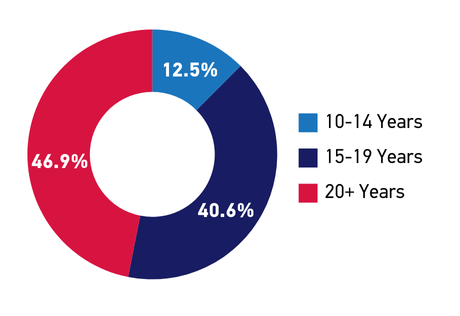
Past Participant Profiles
Work Experience:
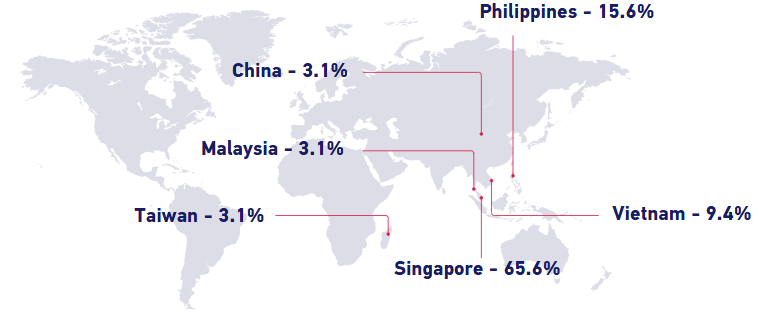
Top Industries:
Top Industries:
Manufacturing
Consumer Products/Retail
Technology/Telecom
BFSI
Healthcare, Biotech, and Pharma
Real Estate/ Construction
Top Geographies:
NTU Associate Alumni Status and Benefits

Lifetime access to NTU email and NTU ASSOC network accounts

Join complimentary webinars and events for career and personal development

Discover career opportunities through our alumni job board

Get regular updates and news on NTU

Join Alumni Associations and Alumni Circles around the world

NTU Associate alumni to receive a 10% tuition fee rebate to support their pursuit of a master's degree

Access to alumni online job board

Discounts and privileges for participating merchants in the food & beverages, travel, accommodation, education and self-enrichment sector
Note: All benefits and the eligibility criteria for the Associate Alumni Status and Benefits are subject to change at the discretion of NTU.
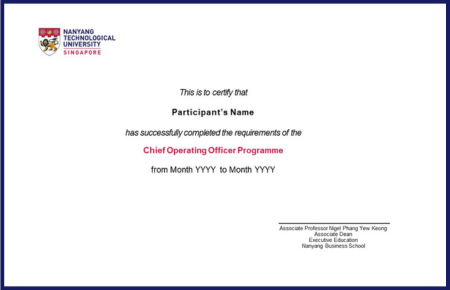
Programme Completion Certificate
Upon successful completion of the programme, participants will be awarded a verified digital certificate by NTU Nanyang Business School.
Note:
All certificate images are for illustrative purposes only and may be subject to change at the discretion of NTU.
*Based on relevant guidelines and degree requirements.
Frequently Asked Questions
What is the eligibility/background required for the Nanyang Technological University (NTU) has designed the Chief Operating Officer (COO) Programme?
The Chief Operating Officer Programme by Nanyang Technological University Singapore (NTU Singapore) is designed for business professionals with a minimum of 10 years of work experience and fluency in written and spoken English.
Who should apply for the Chief Operating Officer (COO) Programme?
The Chief Operating Officer Programme equips senior executives, business leaders, and operations professionals with theoretical knowledge and practical experience to align business strategies with operations, develop leadership skills, and explore data and technology. Ideal for those looking to grow in their roles, the program is offered by NTU Singapore.
What is the programme curriculum of Chief Operating Officer (COO) Programme by Nanyang Technological University (NTU)?
The curriculum of the Chief Operating Officer Programme by Nanyang Technological University Singapore includes core pillars such as COO as a Strategic Catalyst, Functional Mastery for COOs, Technology-Led COO, and Future-Ready COO. It features real-world case studies, interactive sessions, and insights from industry leaders.
Is the Chief Operating Officer (COO) Programme live or recorded?
The Chief Operating Officer Programme by NTU Singapore offers a blend of live online sessions and recorded content, allowing participants the flexibility of self-paced learning while also engaging in real-time discussions.
What is the programme fee for Nanyang Technological University (NTU)'s Chief Operating Officer (COO)?
The programme fee for the Chief Operating Officer Programme offered by NTU varies depending on the session and enrollment period. Please consult the brochure or a program advisor for the most up-to-date information.
Are there any installment or finance options available?
Yes, installment or finance options are available to help participants manage the course fee in a flexible manner. Details about payment plans can be obtained by reaching out to the program advisor.
What are the functions of Chief Operating Officer (COO)?
A Chief Operating Officer (COO) manages daily operations, ensuring efficiency and performance across departments while aligning activities with strategic goals. They oversee resource allocation, process improvement, and project management, collaborating with executives to drive growth. Additionally, the COO mitigates risks, ensures regulatory compliance, and develops talent to maintain a high-performing organization.
What is the job description of a Chief Operating Officer (COO)?
The job description of a Chief Operating Officer (COO) includes executing the company’s strategic plan by managing day-to-day operations and enhancing business processes. The COOs lead cross-functional teams to optimize performance, drive innovation, and improve operational systems. The COOs collaborate with the executive team to ensure seamless integration of business initiatives, aligning resources, technology, and talent to achieve organizational goals efficiently.
What is the duration of the Chief Operating Officer (COO) programme?
The duration of the Chief Operating Officer (COO) programme typically spans for 7 to 8 months, combining live sessions and pre recorded sessions for self-paced learning and 1-day of immersion and networking event at the Nanyang Technological University (NTU) campus.
Why should we choose this Chief Operating Officer (COO) course?
This programme is considered one of the best for aspiring Chief Operating Officer (COO) programme due to its comprehensive curriculum, industry-relevant insights, and focus on strategic leadership. The Nanyang Technological University (NTU)’s reputation for excellence and the program’s focus on real-world application further solidify its value.
Do all participants get certificate of completion?
Upon successful completion of the programme, participants will be awarded a verified digital certificate by Nanyang Technological University (NTU).
Are there any networking opportunities in this Chief Operating Officer (COO) programme?
Upon successful completion of the programme, participants will be invited to attend a 1- Day Campus Immersion and Networking Event at the end of the 9-month journey at Nanyang Technological University (NTU). During this event, participants will have the opportunity to network with fellow global leaders and interact with programme faculty/directors.
What are some of the designations that form the cohort of the Chief Operating Officer (COO) programme?
Some of the key designations are Chief Operating Officer, Director of Operations, Head of Operations, VP Operations, Head of Business Operation, Senior Director Operations, Supply Chain Director, Managing Director, Senior Operations Manager, Assistant Vice President Operations, Chief of Operations.
What is the structure of the programme?
The programme spans over a duration of 7 to 8 months. Throughout the duration of the programme will focus on 4 core pillars. The 4 pillars will focus on key areas such as COO as a Strategic Catalyst, Functional Mastery for COOs, Technology-led COO, Future-ready COO.
Early registrations are encouraged. Seats fill up quickly!
Flexible payment options available.
Starts On